





Eye For Film >> Movies >> A House Of Dynamite (2025) Film Review



A single missile, assumed to be nuclear. From somewhere over the Pacific, but how and why is unknown - one of many facts that will feed conspiracy thinking. There are questions, but few answers. All The President's Men was asking "What did the president know and when did he know it?", but here it's closer to Donald Rumsfeld's quoted koans on kenning.
A House Of Dynamite is an exercise in tension, a thriller without a start or an end, a loop of different perspectives on a few fraught minutes. Written by former journalist Noah Oppenheim, it brings Kathryn Bigelow back to the command and conference rooms that read between the frontlines. There's a countdown, plenty of clocks, but this is not Zero Dark Thirty and boots on the ground. These are separate shoes for commuting and communicating. Bureaucracy, not bullets, praise good and pass the amanuensis. In the credits there's a list of experts, including a US ambassador to NATO, notable as well because of their household connections to the ever-growing department of Homeland Security.
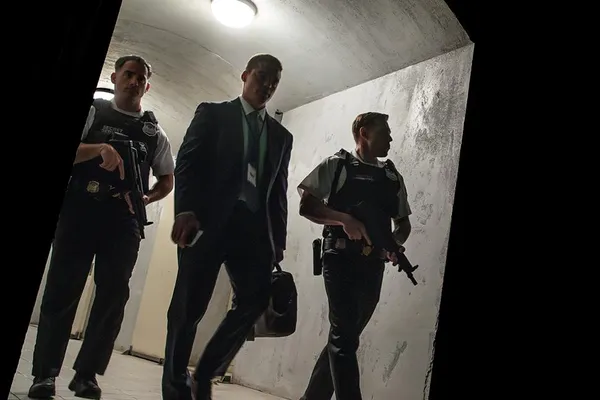
A huge cast, brought together by cars, calls, camouflage uniforms in Alaskan outposts and navy suits in urban bunkers. POTUS is a voice, a presence, credited twice in one of the film's many small uncertainties. "It's not the feed," we're told, but we'll be nourished with a drip of detail. A coin passed from one hand to another, nausea in the North, a line repeated that it's "surrender or suicide" and there will be both.
Three times we'll go over the same territory, an initial launch, acceleration heightening tension, and then the ballistic becomes the baleful. The arc of history bends to a decision, free-fall towards fate. A block of text at the start, three underscored chapter titles. Inclination Is Flattening, Hitting A Bullet With A Bullet, A House Filled With Dynamite. Each reads differently, recontextualised with a successive set of perspectives.
The first chapter is perhaps about orbital mechanics, or political desire. The second is framed by presence at a re-enactment of The Battle of Gettysburg, a turning point of the 1861-65 American Civil War, a place where two bullets struck one another. The third, a consequence of the risks posed by nuclear stockpiles, mutually assured destruction, all that worrying before one can love the bomb.
Across each of them Barry Ackroyd has a camera that is sometimes prowling and proximate and at others caught like deer in headlights. Basketball arenas, helicopters, elevators, traffic jams. A claustrophobia from closeness, every face accumulating with a sum of all fears. It's that naturalistic ability, the feel of the real that informs his work with directors like Ken Loach, Nick Broomfield, Paul Greengrass. It grounds everything. There is a later aerial shot with an airframe that must have been CG as this was made without US Department of War co-operation, and its shadow is slightly suspect. I noticed it because that's the way I tilt, but talking about it and the language I have to use feeds into the film's feel. Call it a lampshade, it's certainly a lighting issue. The only one though, really, as everywhere else there isn't time to do anything but react.
Over all this Volker Bertalmann's score. Contrabass of various stripes are there from the opening, a deep rumbling of other nuclear fears rising up from the depths. A whole additional orchestra of strings brought in to drown us in sound, a submarine equipped with ballistic missiles has a fin and it lurks unseen like any shark.
Oppenheim is no stranger to the White House, Jackie is full of places where things are not. A House Of Dynamite is full of places where everything is dangerous. Bigelow's films boast exceptional casts from whom she elicits and captures all manner of nuance, and this is no exception.
These names alone might be enough to persuade audiences to watch, but even without they'd be rewarded. A House Of Dynamite will have had limited cinematic showings before its producers, Netflix, bring it to homes. It certainly strikes closely, that unattributed missile is doom to the domestic. Life has been going on, it always does, before. Glimpses of it in the performances of Rebecca Ferguson, Idris Elba, Greta Lee, Jared Harris, Renee Elise Goldsberry, Jonah Hauer-King, Willa Fitzgerald, and more and more and more. When we revisit these moments we'll get other parts of conversations, groundwork. History is written by the victors but in the moment there aren't winners, losers, just observers. The mechanics of film mean we're wound as tightly as the music but we're being kept by the score.
Mechanisms can be crafted for precision, for reliability, and these can be opposing goals. In A House Of Dynamite the uncertainties are propulsive, what we learn unsettling. Each tick of the clock reorients our understanding of the same events. Those involved are precise, reliable, and this is an excellent piece of craft. As events unfold, refold, expand, we are given exactly enough room to speculate, to consider, to dread. This joins a litany of films that ponder nuclear peril, including Bigelow's own K-19, but titles like Fail Safe, Miracle Mile, Threads, The China Syndrome, Oppenheimer are all inflected by their age and authors. Heisenberg and Schrodinger both had perspectives on observation and A House Of Dynamite adds new spin to fundamental particles of story.
Reviewed on: 13 Oct 2025


Director: Kathryn Bigelow
Writer: Noah Oppenheim
Starring: Idris Elba, Rebecca Ferguson, Gabriel Basso, Jared Harris, Tracy Letts, Anthony Ramos, Moses Ingram, Jonah Hauer-King, Greta Lee, Jason Clarke
Year: 2025
Runtime: 112 minutes
Country: US
Search database:
